



Ribbon Slitting Machine: Fully Automatic or Semi-Automatic? A settlement of your choices

Posted by delishslitter
from the Business category at
22 Sep 2026 12:33:50 am.
Share this page: 


There is no standard answer to this choice; the answer is hidden in your order structure, labor ledger, and quality requirements.
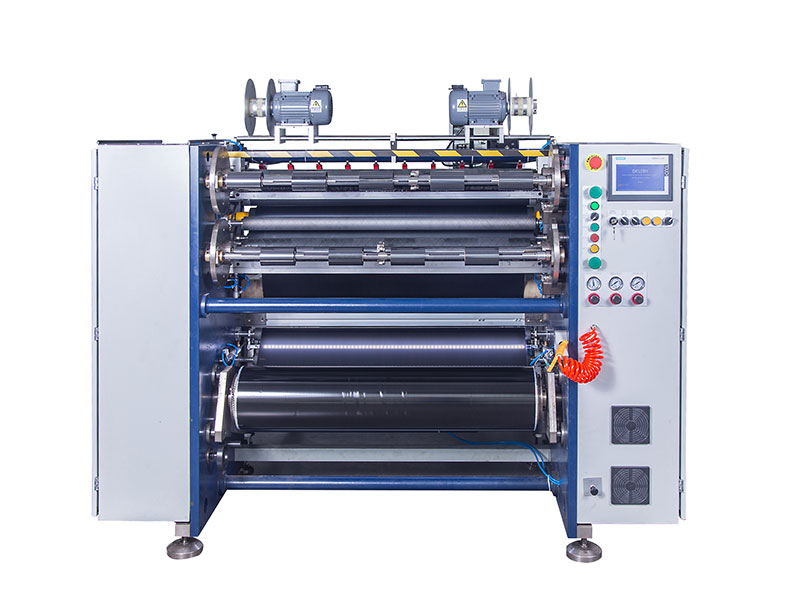
Semi-automatic: A practical choice for flexible starts
The semi-automatic ribbon slitting machine is not synonymous with being "outdated." Its core advantages lie in low investment thresholds and flexible order exchanges.
From the working principle perspective, semi-automatic models require operators to manually complete certain steps—feeding, film introduction, film connection, or assisted alignment after parameter settings. This determines its reliance on manpower: a skilled worker can usually only manage one or two pieces of equipment, and technicians are needed to adjust parameters when changing specifications.
But this precisely matches the real needs of a certain type of company. If your business involves small batches and multiple varieties, with frequent order specification changes, the "manual flexibility" of semi-automatic models actually becomes an advantage. Operators can adjust at any time without having to reprogram each order. The industry selection guide also points out that semi-automatic models are suitable for "small batches, multi-variety production, with low investment thresholds."
Looking at the specific parameters, the mainstream semi-automatic ribbon slitting machines on the market do not have low speeds. For example, some semi-automatic models can achieve nominal speeds of 300-350 meters per minute, comparable to the base speed of some fully automatic models. The shortcoming of semi-automatic cars isn't speed, but the "human-machine ratio."
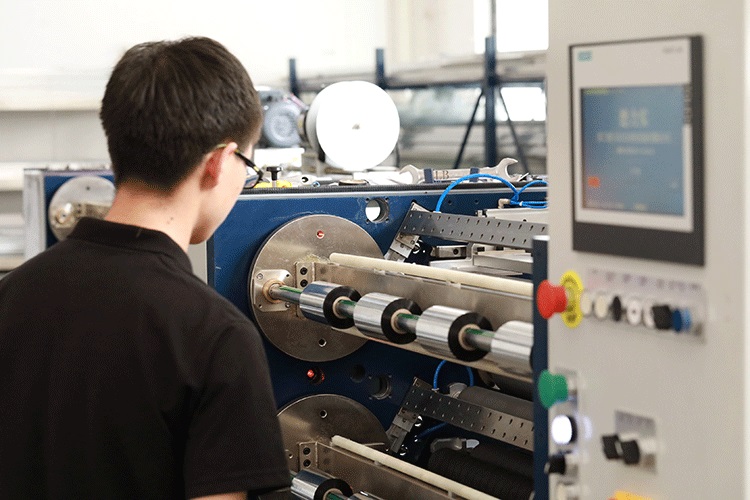
Fully automatic: rational selection when calculating the general ledger
The value of a fully automatic slitting machine can only be understood by carefully calculating the "general ledger."
The core capabilities of fully automatic models lie in automatic feeding, automatic tension control, automatic deviation correction, automatic discharge, and automatic pipe change. After operators set parameters, the equipment can run continuously, and workers only need to handle abnormalities and replenishment.
This means a fundamental change in the human-machine ratio. In semi-automatic mode, each machine requires one dedicated operator per shift; In fully automatic mode, one worker can care for 3 to 5 machines simultaneously, with some high-end configurations even reaching 8 to 10 machines.
The gap between manual accounts is staggering. For example, a workshop with 10 machines works two shifts daily:
The semi-automatic mode requires about 20 operators, and with the actual support staff at 22-24 people, based on a monthly comprehensive cost of 6,000 yuan per person, monthly labor expenses are about 130,000 to 140,000 yuan. In fully automated mode, the same capacity requires only about 6 workers, with monthly labor costs around 36,000 yuan. Saving nearly 100,000 yuan per month, and over 1 million yuan annually.
This account does not include gains from reduced scrap rates. Tension fluctuations and alignment deviations caused by manual operation in semi-automatic systems often have a defect rate of 2%-3%; Fully automatic equipment offers high precision and good repeatability, with a defect rate controlled within 0.5%.
More than just saving people: the hidden watershed for quality stability
The core challenge in ribbon slitting lies in the extremely thin material—the base film thickness is only 4.5 to 20 microns, making it extremely sensitive to tension. Excessive tension causes the base film to stretch and deform; too little causes it to loosen and wrinkle.
The core advantage of fully automated equipment lies in closed-loop tension control. It uses sensors to monitor and automatically adjust the tension at each stage of unwinding, pulling, and rewinding, ensuring constant tension throughout the slitting process from full to small rolls. High-end models are also equipped with taper tension control, automatically reducing tension as the roll diameter increases to prevent the inner ribbon from sticking under pressure.
Semi-automatic equipment is not without tension control, but the more steps are manually involved, the greater the likelihood of fluctuations. When your products target scenarios such as high-resolution barcodes, precision electronic tags, or medical labels, and the accuracy requirement reaches ±0.1mm or even ±0.05mm, the stability ceiling of manual operation becomes a quality bottleneck.
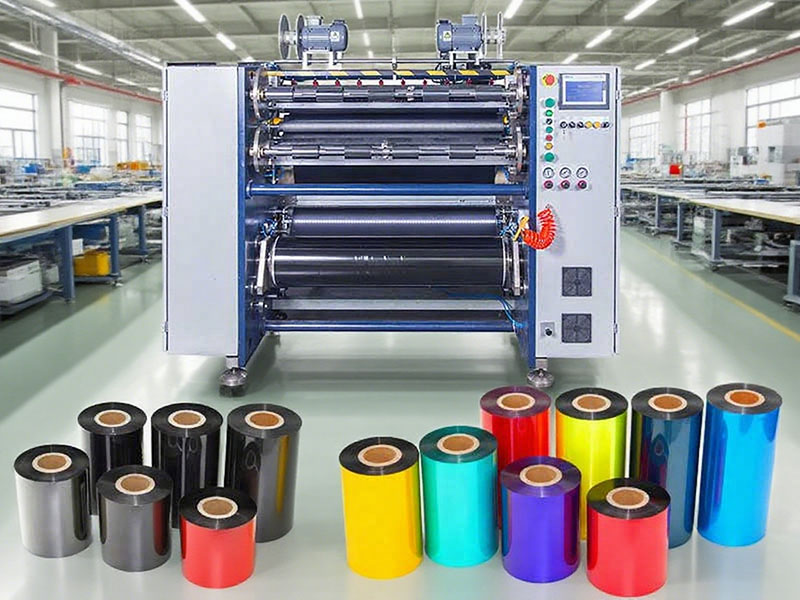
Decision framework: Take it personally
Choosing a model isn't about "the more expensive, the better," but "the more you match, the better." A clear decision-making framework can help you quickly position:
Choose semi-automatic if your situation is: startup or small-scale production with under-saturated orders; Frequent changes in product specifications, with small batches per batch; Limited budget, sensitive to payback cycles; Slitting accuracy requirements are relatively lenient (± 0.3mm or more).
Choose fully automatic if your situation is: mass continuous production with stable order structure; High labor costs or difficulties in recruitment; Products targeted at the high-end market, with precision requirements ± within 0.1mm; Pursue long-term optimal total cost of ownership rather than the lowest purchase price.
It is worth mentioning that even for semi-automatic models, it is recommended to prioritize those equipped with closed-loop tension control systems. Tension control is the "soul" of slitting quality; regardless of the level of automation, this core component cannot be compromised.
Conclusion
Selecting delish ribbon slitting machine is essentially a matter of calculating the return on investment. Semi-automatic means "trading manpower for flexibility," while fully automatic means "trading capital for efficiency and stability." The former is suitable for the initial stage and fragmented orders, while the latter demonstrates overwhelming cost advantages in large-scale production.
The one-time investment for upgrading to full automation is indeed substantial, but based on labor savings and waste reduction, most carbon ribbon manufacturers can recoup their investment within 6 to 12 months. In today's world of rising labor costs and increasingly stringent quality requirements, fully automatic slitting machines are no longer a question of "whether to use them," but rather "when" to choose the right timing.
Ultimately, the answer depends on your order structure, manpower ledger, and quality ambitions. Once you calculate the score, the choices are naturally clear.
0 Comments