



Uneven end faces of film slitting machines? This is how to adjust the tension when rewinding

Posted by delishslitter
from the Business category at
24 Jul 2026 01:27:00 am.
Share this page: 


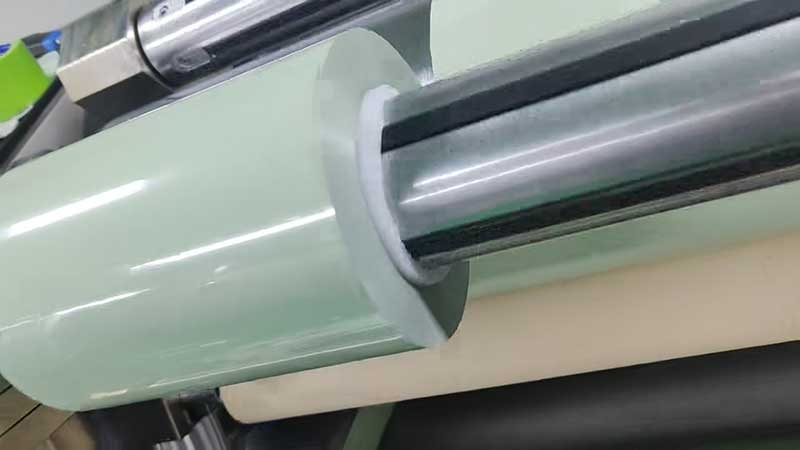
The root cause of uneven demeanor is far more than just Zhang Li
There are two common forms of face misalignment: one is irregular unevenness, and the other is wavy, regular offset. To solve this problem, we first need to find the "real culprit."
Misaccomplishments in photoelectric tracking are the most easily overlooked reasons. The film slitting machine relies on the photoelectric eye to identify the tracking lines on the film to achieve correction. If the photoelectric eye is not properly adjusted or if the color difference between the tracking line and the film background is not obvious, the correction system will "go blind" or "hesitate," causing the film roll to naturally deviate.
Static electricity is also not to be underestimated. During high-speed slitting, friction generates static electricity, causing the film layers to repel or stick together. During winding, the film becomes "unstable," making it difficult for the end face to be neat. When static electricity is severe, it can even cause the film to absorb dust, affecting products with high cleanliness requirements.
Problems with the equipment itself can also lead to uneven end faces. Unbalanced unbalance of the unwinding pressure roller and inconsistent parameters of the rewinding arms at both ends cause uneven force on both sides of the film roll, resulting in uneven wavy end faces. Additionally, if the slitting speed changes too quickly, the smooth surface of the film can also cause layer displacement due to inertial slip.
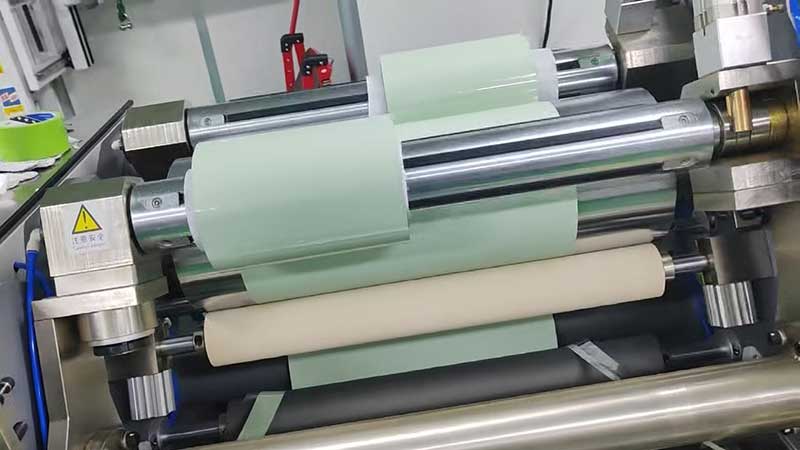
Winding tension: the "core switch" of uneven ends and faces
Among all factors, the winding tension has the most direct impact on the straightness of the end face. If the tension is too low, the film roll becomes loose, interlayer air cannot be expelled, and the film may slide laterally; Excessive tension causes the film roll to be tightly tightened, resulting in uneven lateral stress, which can also cause misalignment of the end-face layers. Tension has no "universal value" and must dynamically change with the slitting process.
Taper tension control is the core approach to solving this problem. As the reeling diameter continues to increase, the film roll weight rises. If constant tension is maintained, the outer film layer will exert excessive pressure on the inner layer, causing the inner layer to wrinkle or slip laterally. The correct approach is: as the roll diameter increases, gradually reduce the winding tension to keep the film roll in an ideal state of "tight inside and loose outside."
Modern slitting machines are commonly equipped with closed-loop tension control systems, which detect film tension in real time through tension sensors and automatically adjust the winding torque after PID calculations. What operators need to do is set the tension taper curve—that is, the attenuation slope of tension as it changes with the roll diameter. Different materials and thicknesses of films require completely different taper curves:
• Thicker, stiffer films (such as BOPP, PET): require higher winding tension, and the taper can be smoother
• Thinner, easily stretched films (such as PE, CPP): require lower winding tension, steeper taper, and slow acceleration and deceleration
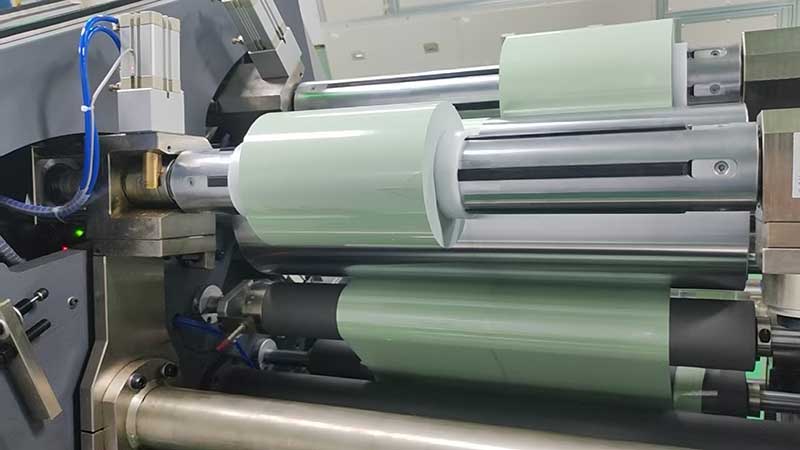
Practical Adjustment: From "Relying on Experience" to "Teaching Methods"
1. First, confirm whether the foundation tension is "within the range"
Different films have recommended tension ranges that can serve as reference points. For example, in lithium battery separator slitting, the winding tension is generally controlled at 0.06~0.12N/mm. In actual operation, you can start with the recommended lower and middle limits of the values, observe the condition of the film roll end face, and then make fine adjustments.
2. Observe the shape of the end face and diagnose tension issues in reverse
• The end face shows a "honeycomb" looseness, with obvious slip between film layers → tension is too low, so it is necessary to appropriately increase the winding tension or reduce the taper attenuation rate
• The end face shows "wavy" undulations, the film roll surface is too hard→ tension is too high, or the taper attenuation is insufficient; the tension setting should be lowered or the taper increased
• One side of the end face is aligned, the other side is unaligned → Check whether the pressure at both ends of the winding compression roller is consistent and whether the winding arm parameters are symmetrical
3. Coordinate with roller pressure to avoid "making things worse"
The function of the winding press roller is to extrude air between layers and cushion vibrations. Excessive pressure on the roller worsens the "loose inside and tight outside" effect; too low pressure causes excessive air entrapment, causing uneven end faces. The pressure of the roller should gradually decrease as the coil diameter increases, adjusting in coordination with the tension taper. The diameter of the pressure roller should also be smaller than the final diameter of the film roll; otherwise, excessive wrapping corners will allow more air to be rolled.
4. Make good use of the "memory function" to solidify mature parameters
For frequently produced film varieties, it is recommended to store successfully matched parameters such as tension curves, roller pressure curves, and speed. Next time you switch to similar products, you can call them directly, saving time and providing stability.
Conclusion
Face misalignment has never been caused by a single factor, but the winding tension is undoubtedly the most critical controllable variable. The essence of tension adjustment is not simply to "tighten" or "tighten" or "tighten" it, but to make the tension "smartly" dynamically adjust according to changes in roll diameter, speed, and material. Next time you encounter uneven ends, why not ask yourself three questions first: Is the tension taper set correctly? Has the roller pressure kept up? Is acceleration and deceleration too fast? Once these three points are aligned, the neatness of the end face will naturally follow.
2 Comments
Comments
Great tip!
Thanks for sharing this practical guidance on tension adjustment for film slitting machines. I've been struggling with uneven end faces on our rewinder for weeks, and this explanation really clarifies what might be going wrong. The step-by-step approach makes it easy to follow, even for someone like me who isn't a machine expert. I'm definitely going to try these adjustments on our setup and see if it solves the problem.
https://ticket-ranking.co.kr
https://ticket-ranking.co.kr
Posted by wonderful
at 01 Aug 2026 12:25:10 am.
Great tip!
https://ticket-ranking.co.kr